
Dad Dick Summer
Plus: the tyranny of tote bags
Good morning,
Some highly questionable amusements in this week’s newsletter:
A long, hard look at Millennials’ dads’ dicks
The tyranny of totes
Poetry and ‘pissed-off collagen’
A library quest!
But first: an offer.
You might not yet own the first three issues of The Little Review in print. If so, this is, of course, horribly embarrassing for you. Don’t worry. You needn’t walk around with a paper bag over your head. There’s still time to remedy the situation before word gets out. For the next few weeks, we are selling a Back-Issue Bundle for £10.
A tenner, for all our past issues. A year’s worth of interesting writing – 528 small but perfectly formed pages of poetry, fiction, reviews, interviews, crosswords, cartoons, insolence & triviality – for less than half the price of this months’s vegan harissa special at Pizza Express. You can order it here. (‘It’ being the bundle, not the pizza.)
And now, amid a summer heatwave, we look back at a memorable summer in the recent history of poetry, courtesy of this highlight from TLR No. 3…
Insolence & Triviality:
Dad dick summer: a serious retrospective
Recently I fell down a rabbit hole of poems about Millennial men’s fathers’ penises. When family and friends asked what I was doing, I said I was tracking down ‘dad’s dick’ poems from 2018 to 2020. Though most were bemused that this subgenre existed, two helpful friends proffered almost simultaneously a ‘proto’ dad’s dick poem by British poet Henry Shukman, who now lives in the US as a Zen master with a meditation app.
‘Man Peeing’, which appeared in his debut collection In Doctor No’s Garden (2002), relays a boyhood memory of the ‘fireman’s jet’ of urine emerging from his father’s ‘thing’, which was ‘heavy and thick, a length of rope’. Initially there is identification, so when the father lets out an ‘arse squeal’ and laughs, the boy echoes his laugh. But later a hint of disavowal is detected. The son recognizes that his father, a man of ‘small stature / but some standing’, belongs to ‘another world’ – of adulthood, privilege and patriarchy – where ‘waiters and women waited’.
Why was I hunting for ‘dad’s dick’ poems? The story begins in 2020 with a poem by Joe Dunthorne called ‘The Norton Anthology’ from issue 95 of Poetry London. ‘It was the summer we all wrote poems about how our dads’ dicks / noisily follow us everywhere…’ are its droll opening lines. I assumed this ‘summer’ was intended allegorically as an era in which toxic masculinity was confronted. But no: it was literal. Or so I inferred from the acknowledgment under the title – ‘after Wayne, Raymond and Dean’ – which signalled antecedents in the dad’s dick canon.1 ‘The Norton Anthology’ offers a mythologized genealogy of Dunthorne Family sex organs, from the ‘exclusively symbolic’ balls of a vasectomized father to the speaker’s self-described ‘dreaded shipwreck’. The focus moves to a tiny son in the bathtub with the potential to write his own ‘dad’s dick’ poem one day: ‘He stares into the future. I promise I will not let them / publish the anthology until his poem feels right’.
Funny and smart, the poem hints at the Narcissus myth: a man looks admiringly into a body of water (a bath) at his reflection, which here takes the form of a son destined to write a poem on the identical subject to the one that the poet is self-consciously watching himself compose. But there is an entire hall of mirrors. The speaker is a reflection of his father, the boy a reflection of both father and grandfather, and each ‘dad’s dick’ poem a reflection of the others. There’s a note, too, of what Freud would call secondary narcissism in the grandiosity of imagining the son’s unwritten ‘dad’s dick’ contribution in The Norton Anthology. I thought the poem was hilarious.
I transcribed the text, saved it in a folder for my PhD research, then life got in the way – there are things that are important beyond all this fiddle – until I found myself in a pub in 2025 conversing with poets I hadn’t seen in years. There someone mentioned a poem in which Raymond Antrobus thanks his father for his large penis. I was suspicious of the way this poem was reported: I didn’t associate Antrobus’s work with flexing, in contrast, say, to Frederick Seidel’s boastful affectations – but even Seidel would be unlikely to congratulate himself on the size of his member. So I borrowed The Perseverance from the library and looked up the poem in question, ‘Thinking of Dad’s Dick’.
Here, as is so often the case, the truth lies in between. While it is correct that the speaker points out how wide and long his father’s penis was and then says, ‘Funny to thank him for this now’, the remark seems parenthetical on the one hand and, on the other, necessary to the poem’s conceit: patrilineal inheritance. Many of the poems in The Perseverance grapple with ambivalence about a dead father. Even the redaction of Ted Hughes’s ‘Deaf School’ and the poem that follows (‘After Reading “Deaf School” by the Mississippi River’) position Hughes as a disappointing poetry forefather. In ‘Thinking of Dad’s Dick’, however, ambivalence takes a sentimental turn. The father, who has overshared with his son details of his extensive sex life, is understood to have been aware of his imminent mortality when doing so. He told stories while he could, giving the ‘length of his life’ (note the double entendre) to his son, who now spins his own narratives as a writer. I expect the size aspect of ‘Thinking of Dad’s Dick’ was remembered in the pub because it was emphasized in a 2019 TLS review by Rory Waterman. However, I may be downplaying that detail, unattuned as I am to blokey references to penis size.
The acknowledgement under Antrobus’s title – ‘After Wayne Holloway-Smith’ – rang a bell, though I hadn’t connected the dots to Dunthorne’s poem. By googling ‘Wayne Holloway-Smith Dad’s Dick’, I found on the Poetry Society website the progenitor of the 2018-2020 ‘dad’s dick’ poems. ‘Dad’s Dick’ was originally published in The Poetry Review in the summer 2018 issue. (Could that be the ‘summer’ Dunthorne references?) The poem is one of several ‘Extracts from Love’, i.e. fragments of Holloway-Smith’s book-length project on toxic masculinity and maternal sacrifice, Love Minus Love, published three years later. In the book, the extracts appear without titles; and the poem formerly called ‘Dad’s Dick’ conveys, via its newly implemented all-caps text, associations of billboards, street art, and perhaps Trump’s obstreperous shouting on Twitter.
How directly does Antrobus model his poem after Hollway-Smith’s? Not very. While Antrobus’s ‘horse’s tongue’ echoes Holloway-Smith’s ‘Floppy dog tongue’, the latter’s ‘Dad’s Dick’ is its own beast – and why shouldn’t it be? This twenty-line list of associative epithets is a bald take-down of toxic masculinity and patriarchal dominance, reaching a literary register with vocabulary such as ‘lyric I’ and ‘protagonist’. Its form – a series of put-downs that includes ‘Lifter of toilets seats / Maker of stains / Itcher / Nervous twitcher / Drunkard / Stitcher-up of mother’ – conveys a one-tone renunciation of a father, less nuanced than others in this public conversation. But there was one more poem to find.
Locating Dean Atta’s poem, the remaining participant in the dad’s dick repartee, proved so difficult I found myself in a quandary: was I really going full Miss Marple to track down the final ‘dad’s dick’ poem? Yes. Yes, I was. KM [… Read the full essay in The Little Review No. 3, available in print or as a PDF]
Totemic Polemic
We often receive peculiar letters. You may remember the saga of Mr Paul Illidge. Last year, we received the impassioned letter below, which we were pleased to print in the Mailbox section of TLR No. 2.
~
Dear London Review of Books, [We fear this letter may have been misdirected – Ed.]
Yes, I will accept your generous offer of a 25% saving on a year’s subscription. On one condition: you take the free tote bag and stuff it where Donne’s sun don’t rise. Or recycle it as a breakfast snack for constipated essayists.
Prufrock may have measured out his life in coffee spoons, but I have witnessed that ‘eternal Footman’ hold out my tote and snicker. My obituary will be written in thin bags, from the Conway Hall Small Publishers’ Fair to the Uzbek Dried Fruit Symposium. I have enough jute-canvas derivatives in my hall cupboard to rig a tea-clipper and bale up most of its cargo. They may even be having little toties of their own. I cannot recall visiting The Oxford Batman Museum and I was never a delegate at The Dublin Confederation of Punk Fisheries or the East Midlands Cheese and Haiku Summit. Total blackout. If you saw me there, please get in touch.
Maybe all this Totism is a Bloomsbury thing. I see that your neighbours at Faber feature a black linen number among their top-selling items, printed with a quote from Sylvia Plath’s ‘The Rival’:
If the moon smiled, she would resemble you.
You leave the same impression
Of something beautiful, but annihilating.
An odd choice of words for something that fans will stuff with organic vegetables. Mark Fiddes2
~
After reading the missive above, we knew what we had to do.
The Little Review now sells a tote bag.
Out of spite.
It comes in one colour – yellow, naturally – and is sensibly priced at £2.

Aside from the words ‘The Little Review’, the bag is mercifully blank. This is, we believe, a distinctive selling point. We have not printed any poetry on it – and certainly none of the editor’s own poetry. (This is, alas, more can than be said for bags currently being sold elsewhere. We hope other magazines will learn from our sense of restraint.) TLR
Review of the week:
‘You furious excuse for a buzzcut’
Take up a piece of silk. Bafflingly smooth, it only exists because of the slow movement of worms, their secreted saliva which forms cocoons, harvested and boiled to kill off the pupae inside, separated and spun into thread, woven into fabric by many hands. All of which happens somewhere else, and yet is manifested here in this square of fabric that you touch, softer than skin.
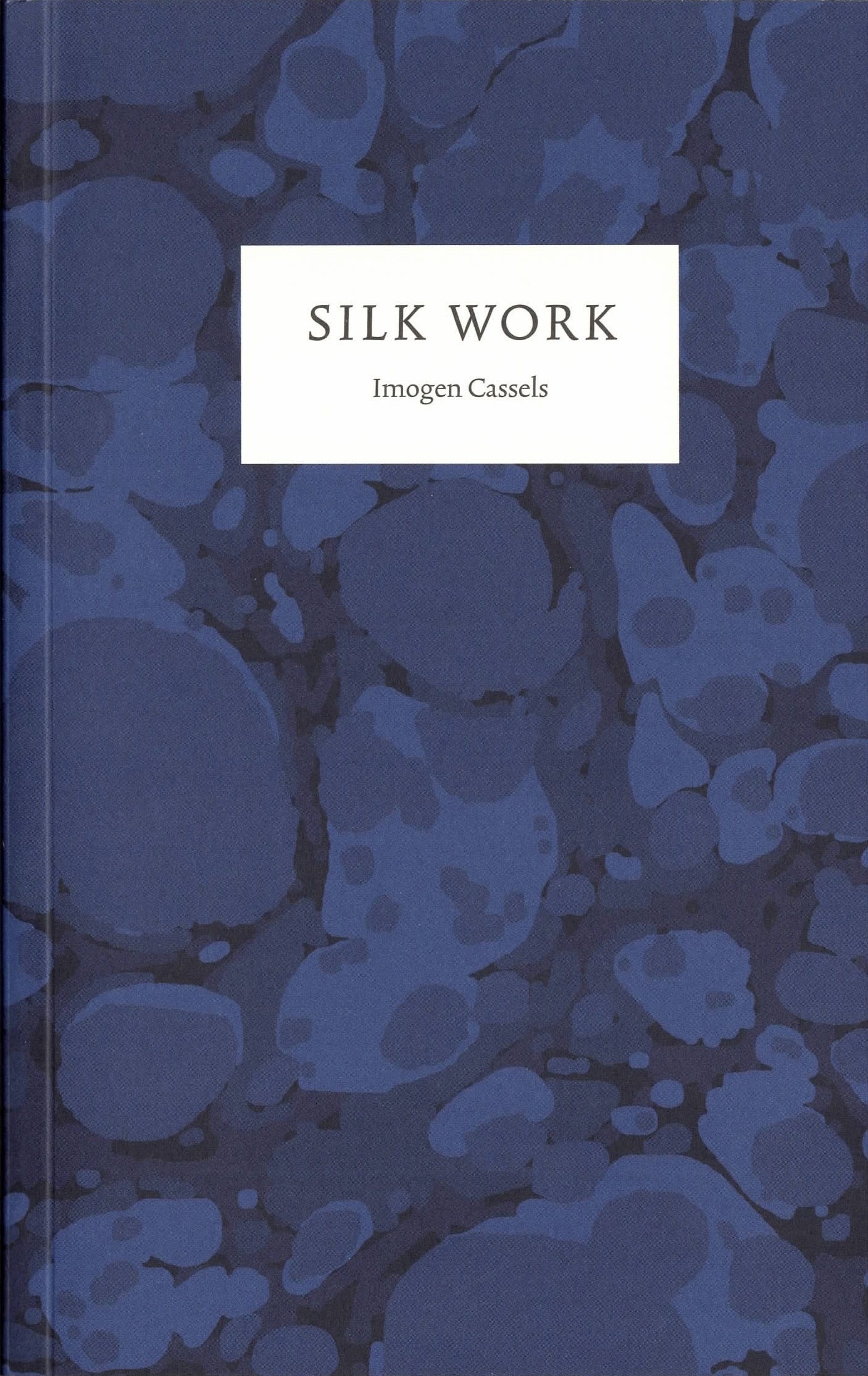
Silk Work, the first poetry collection from Imogen Cassels, asks us to consider these kinds of transfiguration; how things and the words that try to contain them are at once simple and mind-spinningly complex, touchable and beyond our reach. Across the poems, Cassels conjures images only to undercut or revoke them, or to create a sense of simultaneous absence and presence. We find the ‘quiet insistence of snow elsewhere’, the ‘Vacation of a nerve’ instead of the nerve itself, an ‘un-blue’ streak, an unpinned comb, the ‘anti-movement of birds’. At other times the objects in the poems feel more deliberately evasive or wrongfooting: ‘the shadow of a burn so wild / it would uncondition the familiar’, a ‘wrong blossom’ and ‘mock of atoms’. These are images which leave us unsettled, as though we’ve been given and cheated out of something precious in one swift movement.
There is a great seam of irreverence throughout the collection. One part of an eight-sonnet sequence is titled ‘Pissed-off collagen’; ‘After Petrarch’ continues with the run-on, ‘who art in heaven, my razors / have behaved oddly’ which chimes nicely with an insult hurled in another poem, ‘you furious excuse for a buzzcut’. But this humour is balanced with moments of tenderness and longing. Cassels captures the force of sensory memory and the tricks that language plays in trying to make sense of the past; ‘The smell of you in summer or in Oxford, so painful / it’s amazing’. The move between cerebral and embodied life here is at once fluid and jarring. Phrases like ‘A handful of goddesses’ and ‘a little hinge of Shoreditch’ are inviting nooks offered up as shelter in poems otherwise imbued with unease and irresolution.
The collection’s language is musical, full of slant rhymes (larch and lurcher, tinder and tundra) that feel playful and light. But there is always a sense of a hand in control, striving for order and the ‘sweet surgery’ of putting words into a relationship that will allow them to take on the charge of the real life behind them. We are being led in a dance that sometimes trips and jerks us, where language is both communicative and a material that draws attention to itself. Much of the time, it is hard to say what these poems are ‘about’. Syntax is often dizzyingly disordered and words are made to subvert their categories, like the pleasingly disruptive noun-adjectives in the reproach, ‘How group photograph / of you. So sonnet, so love letter, so parting shot’.
At times I questioned whether the poems’ insistence on language’s artifice came at the expense of something more open and emotionally connective. But perhaps this is the point; that we cannot escape language’s limits, even if we try. As readers, we are implicated in this struggle as much as Cassels – accused, aroused, craving something impossible. ‘Each want is past having / which is why I wanted it’, we are told, and ‘the point of hope is that it falls through’. And yet, these aren’t despairing poems – far from it. They are curious, lively; they insist on the point of continuing, of being (and writing) ‘proof against breaking’. They feel like splashes of icy water to the cheeks after a long and comfortable sleep. ADA
Silk Work by Imogen Cassels (Prototype, 2025; £12.99)
Poem of the week:
Another Labyrinth
In our everyday life we lose much time hunting for things for which we have no definite place. – The Library Assistant’s Manual
Rædwulf, buried in the most easterly wing,
grips a facsimile of the Voynich manuscript,
pausing on a page which has been ripped.
‘Find Forthwind, or Tybalt,’ he tells you. ‘Get going.’
Mort hovers over The Aim of the Sage
like a naked bulb, clicking his wooden teeth,
which he uses to ease the needle from its sheath.
‘Deliver to Asher or Forthwind,’ he says, ‘this message.’
Tybalt is in the cloister, reading aloud
from the Book of Thoth, or a convincing fake,
while cradling a mead headache.
‘Tell Mort, or Blanc, or Asher: the vellum’s yellowed.’
Forthwind is scrawling, with thin pen and thinner ink,
in the margins of d’Abano’s Heptameron,
smoking tobacco flavoured with coumarin.
‘Iseult. Or Mort.’ He pauses. ‘I’d like to know what they think.’
Asher, slumped by a quarter-full cup of peyote tea,
is using La Poule Noire for a pillow.
He sighs like a cello:
‘Surely, oh surely Blanc or Forthwind understands beauty?’
Iseult is grimly filleting The Key of Solomon
when it catches the tongue of her candle.
She thrashes at the flamelet: ‘Out, scoundrel.’
Then to you: ‘Tell Tybalt. This is an omen.’
Blanc is nowhere to be seen.
Missing too is the Papyri Graecae Magicae
and several texts which, to the phlegmatic eye,
are only harmlessly obscene. JS
Wayne Holloway-Smith, Raymond Antrobus and Dean Atta; omitting their surnames strengthens the sense of the poem as a joke between friends.
Mark Fiddes, a frequent contributor to TLR, will be better known to some readers as ‘MF’.
As a tote bag connoisseur - or ‘Toteur’ as they say in this part of the world - I endorse The Little Review’s distinctive yellow tote as the perfect receptacle for extra gift copies of TLR, a Pret tuna baguette, artisanal crisps and a lunchtime can of Special Brew.
Enjoyed this very much. The TV show Workaholics (Season 3 Episode 6) discusses paternal penises.