
Men, men, men
Plus: a surrealist buys a second-hand loo from a nun
Hello,
In this week’s multifarious newsletter:
In Some Untidy Spot (our occasional series on art and artists), we take a long, hard look at the erotic magic of Ithell Colquhoun
Tackling 5,000 years of patriarchy – with a little help from Anne Carson
A dicey new poem by AAP
If you enjoy The Little Review, and have been vaguely meaning to subscribe – well, it’s only £12 for a full year of print magazines. What are you waiting for?
Don’t let ‘I dare not’ wait upon ‘I would,’ like the poor cat in the adage. Seize the day and click this shiny button:
Some Untidy Spot:
Occult Condoms
Magicians do not welcome ridicule. The 19th-century mage Éliphas Lévi warned any readers who might scoff at his ‘transcendental science’ that ‘you will endeavour to laugh at it, and will only gnash your teeth.’ But when, in occult circles, are we permitted to laugh? This question must bother readers of Ithell Colquhoun (1906-88) – the occultist, poet and surrealist whose magnificently odd paintings have been the subject of a revelatory recent Tate exhibition – because she seems to have had highly evolved antennae for precisely the kind of silliness one would imagine to be anathema to magic.
She was, without doubt, serious about magic – by which we mean the belief that there is an unseen world of forces, which we can apprehend if only we tune in correctly. She spent decades trying to join a series of magical groups, from MacGregor Mathers’s Hermetic Order of the Golden Dawn and its dissident offshoot the Society of the Inner Light, to the Ordo Templi Orientis, the New Isis Lodge, the Order of the Keltic Cross and the Order of the Pyramid and Sphinx.
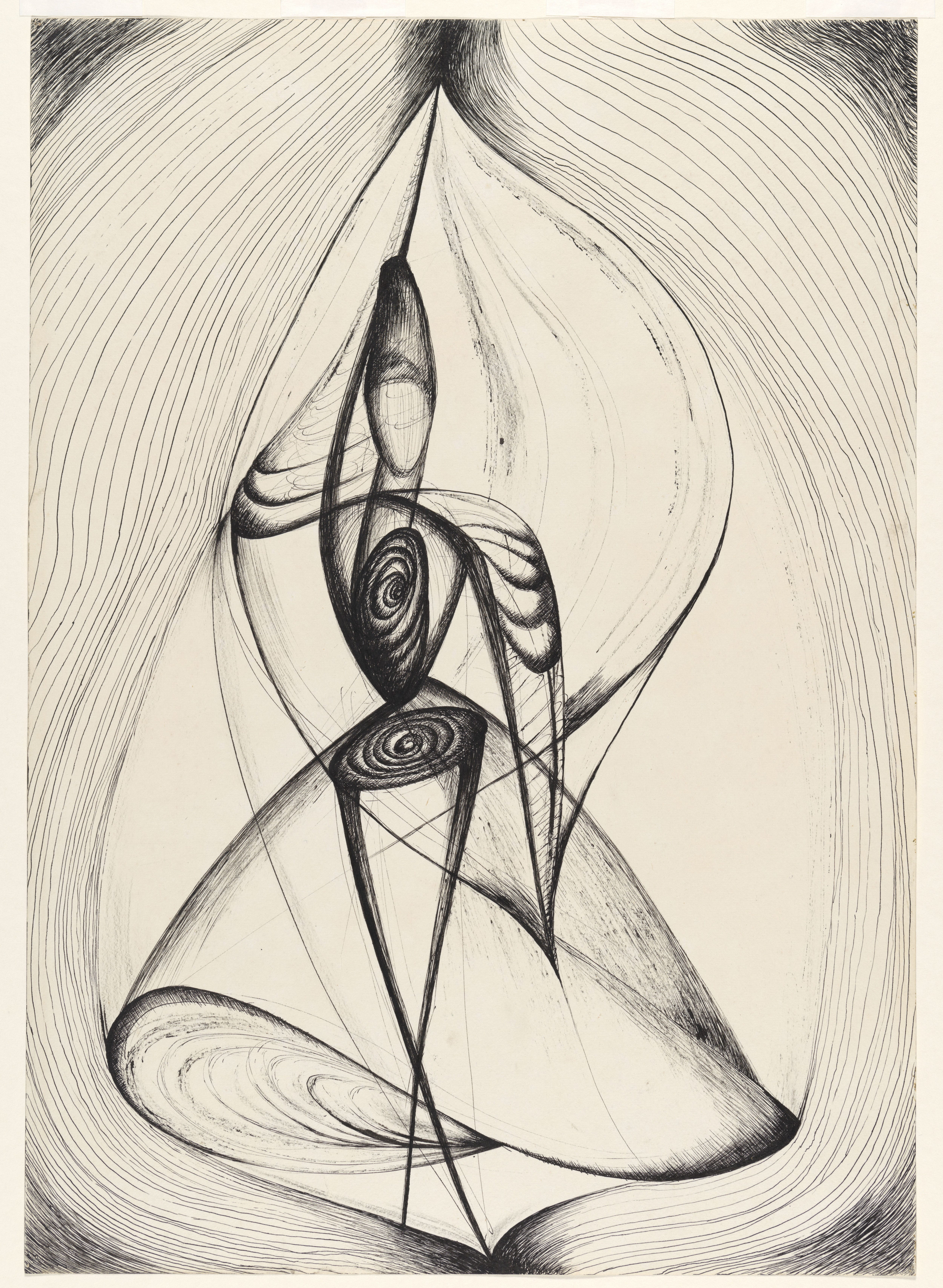
Her paintings were cerebral attempts to plumb the spirit world. She seized on André Breton’s claim in his 1924 surrealist manifesto that automatism – creating images by chance, then interpreting them as a window onto the unconscious – was ‘the fundamental procedure of surrealism’, but she took it further into occult territory, aligning her experimental methods of creating automatic images with the alchemical elements: ‘fire’ was fumage (smoke pictures), ‘earth’ was decalcomania (paint-covered surfaces pressed together then peeled apart), ‘water’ was écrémage and parsemage (mopping pigment off the surface of water), ‘air’ was the puffing of coloured powder onto a surface.
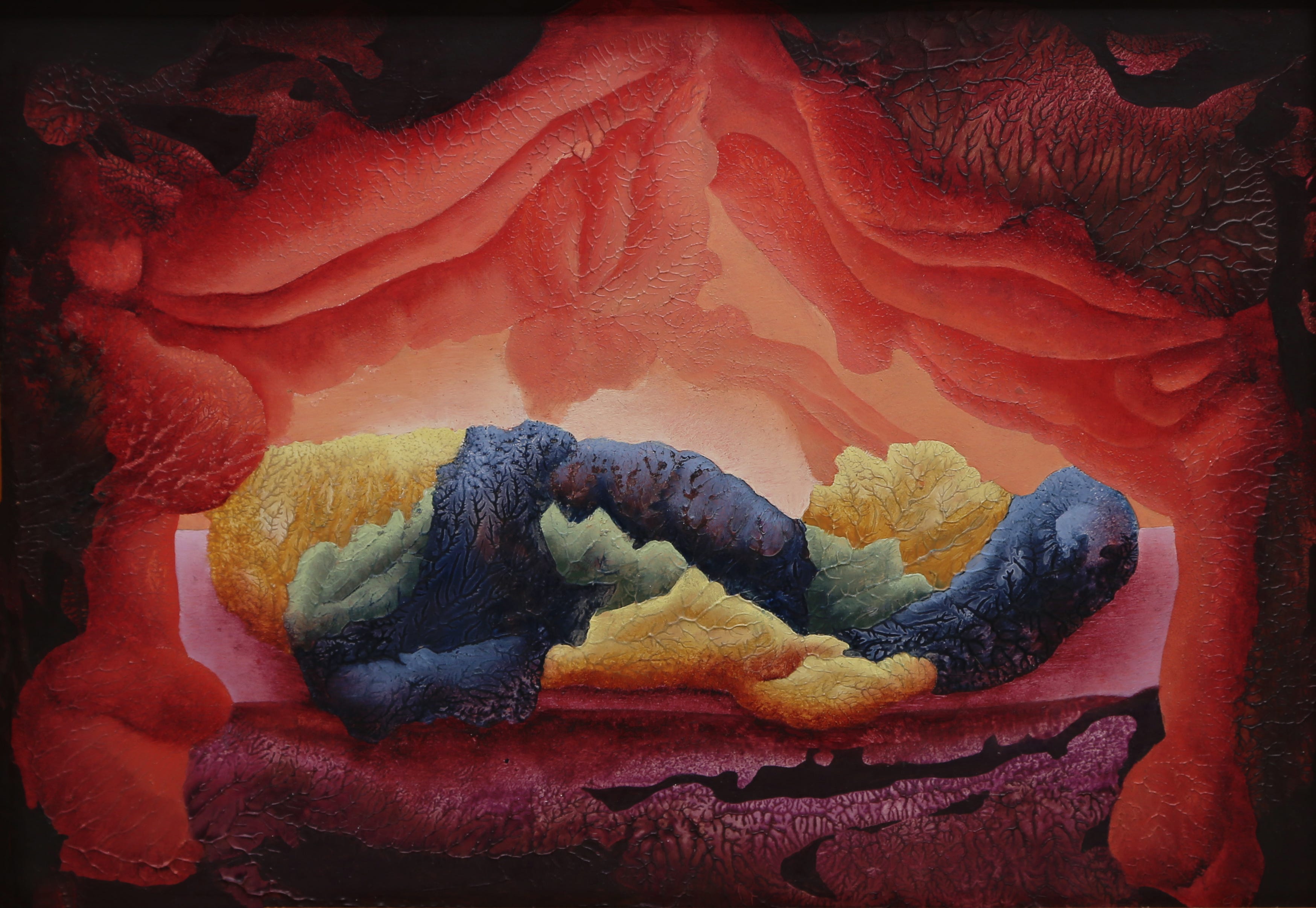
For her, it was the cosmos speaking through these automatic marks. ‘I feel these stains to have a “mantic” or divinatory quality, which may in some sort be compared with the practices of clairvoyants, who use ink-splashes, sand, pins flung together by chance, and the irregular patterns left by tea leaves and coffee grounds to release the contents of the unconscious,’ she wrote.
Colquhoun created a deck of ‘Taro’ (now handsomely reproduced in a set of Tate postcards) in which each card’s meaning is represented by a coalescence of vividly coloured dribbles of enamel paint. Abandoning the traditional Tarot deck’s major figures (The Fool, The Hermit etc), she invented her own: one shows ‘The Lord of the Winds and the Breezes, The King of the Spirits of Air’, a red-and-yellow swirl on green. She wrote abstruse articles on the Golden Dawn’s hermetic colour theories. She adopted a magical name, Splendidior Vitro. In Brittany she was known as Druidesse Boudica.
And it was magic that led her to be banished from the British Surrealist Group. She had joined in 1939, but the group’s doggedly atheistical leader Édouard Mesens expelled her the following year over her refusal to renounce her occult beliefs.
When Colquhoun and her Russian-Italian husband Toni del Renzio (a fellow painter, also exiled from the group) held their own surrealist poetry evening, Mesens ‘reacted violently’, as Desmond Morris relates in The British Surrealists:
He gathered together a gang of loyal friends and they attended the poetry reading, armed with rotten eggs. They began by demanding that a letter of protest be read out to the audience by Ithell. When this was refused, they started to hurl their rotten eggs at the platform, where Ithell and Toni had to take refuge behind a grand piano. After about half an hour of this bombardment, most of the audience had left and the meeting had to be abandoned.
Morris believes Mesens’s rage was, in large part, the sexual frustration of a ‘twice-scorned lover’: his romantic overtures to both Ithell and Toni had been rebuffed.
Given all the above, we can feel confident that Colquhoun was serious about magic. So why, in her writing, does she mate the sublime with the ridiculous? Take her most famous book, The Living Stones: Cornwall, which begins with a deeply felt hymn to the Lamorna valley – ‘Influences, essences, presences, whatever is here… I salute you; I share this place with you. Stirrings of life, expanding spores, limbo of germination, for all you give me, I offer thanks. Oh, rooted here without time I bathe in you; genius of the fern-loved gully, do not molest me, and may you remain for ever unmolested’ – then proceeds to relate her quest to purchase an outdoor chemical lavatory, called an Elsan, from a neighbour who cheerfully confides: ‘I’m just a nun. I was in a convent for over thirty years, and I’ve no idea of the value of anything.’
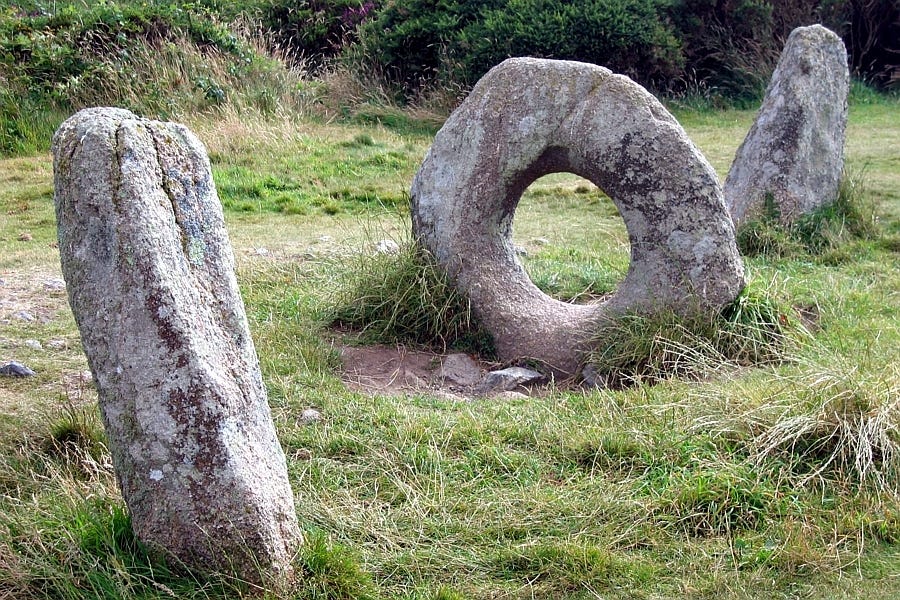
Magical matters, and – even more daringly – their less-than-perfect dependability, are all grist to her comic mill. When she visits the Men-an-Tol, the pierced granite disc memorably described in DM Thomas’s poem ‘Penwith’ as ‘the wind’s vagina’, she records that she ‘crawled from east to west through the ring-like stone set on edge in the centre of this monument as a cure for rheumatism and was disappointed with the result, not knowing that in order to be effective the rite should be performed in a state of nudity.’
This is the voice of a brisk, no-nonsense daughter of empire, born in India and educated at Cheltenham Ladies’ College. For one so spiritual Colquhoun remained remarkably practical-minded, even actively allergic to uncritical woo. Pondering the fetish for ‘the simple life’, she wonders whether it really is simple, ‘when all water has to be carried, the lavatory is a long way down a spooky corridor and the only warmth comes from hot bottles? Is an earth-closet in the garden that has to be emptied periodically really simpler than main drainage?’ She adds that hippie girls in communes must find out the hard way that ‘to keep even relatively warm, clean and fed in primitive conditions is more difficult than in “squarer” surroundings.’
One senses she is not easily hoodwinked. Yet here she is, in full magical flight, in a stanza from her ‘Ode to the Philosophical Mercury’:
December ‘E’ Electra
essence white essence Euphrates|
Eve Fada Favonius
foundation of art diamond lime
precious stone of Givinis white gum
hermaphrodite hoe hypostase
hyle enemy insipid milk
known stone mineral stone unique stone
moon full moon white magnesia
alum mother menstrum
unique matter of metals preparatory mean
setting mercury oil oleum-vivum
vegetable egg phlegm
And so it goes on, a propulsive and hypnotic ‘celebration of the richness of alchemical language,’ as Colquhoun’s biographer Dr Richard Shillitoe puts it. This is a poet drunk on occult dialect, and the moments of apparent bathos, the ‘vegetable egg phlegm’, do not puncture the mood when it is remembered that ‘the philosophical mercury’ is, in alchemy, the female principle. What more concise evocation of the mysteries of the female innards could there be than ‘vegetable egg phlegm’?
And yet, in the same collection, Osmazone, there are pieces that seem to intrude like a whoopee cushion on our attempt to cultivate the reverent, ritual frame of mind that ‘Ode to the Philosophical Mercury’ demands. These intrusions include a prose piece about enemas at Champney’s weight loss spa, a piece of doggerel about the anus (‘it can only speak / when there’s something to say / and then it gives voice / to the belly’s mind’), and an objet trouvé poem about types of condom (‘featherlite fiesta / french tickler / Extrasafe Unison / Long Love Delay…’).
This is no longer the world of the tesseract, the grimoire, and assiduous thumbing of Dogme et Rituel de la Haute Magie. This is the world of sniggering schoolboys and prophylactic wrappers trodden into the mud. Does the second world destroy the first? To return to our original question, are we permitted to laugh?
What is bad for magic may be good for surrealism. The anus doggerel may be part of the hordes of mischievous words that ‘Dada and Surrealism set about to let loose as though opening a Pandora’s box,’ as Breton put it in his second surrealist manifesto (1929). Awkwardness is the aim of the game.
Perhaps Colquhoun, in injecting small doses of mundanity, grubbiness and humour into her poetry, was fortifying her more rarefied magical material as if with a vaccine, showing within Osmazone that these two worlds could co-exist; that alchemy had a place in the Britain of ringroads and condoms. She is pre-emptively getting in on the joke. ‘In a world where everything is ridiculous, nothing can be ridiculed,’ as GK Chesterton put it. ‘You cannot unmask a mask.’ 5 IM
Ithell Colquhoun: Between Worlds (Tate St Ives, February 1 to May 5, 2025; Tate Britain, June 13 to October 19, 2025)
Review of the week:
Numpties
Most people seem convinced that patriarchy has always prevailed, that men have always ruled the roost from bedroom to boardroom, mansplaining their way between the two. Sure, patriarchy has had a good run over the last 5,000 years, but scholars such as Marija Gimbutas, Elizabeth Gould Davis and Chris Knight suggest the previous 200,000 (that lengthy period cunningly dismissed as prehistory) were conducted along much more egalitarian lines. Remnants of matriarchal cultures persist even now – besides neolithic artefacts, there are ancient culinary practices, rare matrilineal customs, Mother’s Day, and the Catholic church’s Madonna cult. But matriarchies that cherished the arts and the common good were destroyed by the advent of metallurgy and, in consequence, the delight in weaponry. In place of creativity we got macho bombast and a suicidal campaign against nature itself.
Men so effectively seized power that they can no longer even conceive of female worth. They can’t hear us. Barbara McClintock’s crucial discovery in 1950 of ‘jumping genes’ was completely ignored for 30 years. Acknowledgement of her work only came when a man found similar evidence that genes mutate. The biologist Rachel Carson, too, told everybody to stop wrecking the environment 60 years ago. Nobody listened. It’s like talking to a brick wall.
In Our Blood (1976), Andrea Dworkin recalled the shock of being censured by her publishers for the forthrightness of her writing. ‘I had been brought up in an almost exclusively male tradition of literature, and that tradition, whatever its faults, did not teach coyness or fear: the writers I admired were blunt and not particularly polite. I did not understand that – even as a writer – I was supposed to be delicate, fragile, intuitive, personal, introspective.’ Nobody was ready for Dworkin. My mother Mary Ellmann’s book, Thinking About Women (1968), exposes a similar strain of difficulty exhibited by male literary critics, who assume only male writers can speak commandingly, with thrust, authority and aplomb, while women writers produce soft, sloppy, slippery, disorderly, passive, unfocussed stuff, in accordance with the supposed characteristics of female anatomy. This confusion of female writing with women’s bodies, she writes, reduces the critical appraisal of women’s literary contributions to ‘an intellectual measuring of bust and hips’. But these days, men don’t even read women’s writing. They find it dull, flimsy, timid, unexciting, irrelevant to their lives, or (the numpties) emasculating.
An aversion to listening to women – an abhorrence of what women have to say and how we say it – is so built into the patriarchal system that it’s become vital to the retention of male rule. Men want us to behave like grass, screaming silently as we’re mown. It has serious consequences: think how rarely rape victims get heard.

The Canadian poet Anne Carson’s witty, deft essay The Gender of Sound (first published in 1992 and gratefully received again now) shows the ways the words and voices of women have been denigrated and placed apart from those of men since ancient times. A classicist and word-collector, Carson walks us through the creaky moves of an age-old oppression, starting with know-it-alls like Aristotle and circling nimbly back through Greek mythology, as she pinpoints the coagulation of many unhelpful ideas. Luckily for the non-classicist, the carefully chosen references to ancient Greek terms are entrancing rather than alienating.
Ingrained misogyny allies the Ancients with the modern era of patriarchy. The Greeks and Romans attacked women’s utterances for both form and content, Carson reports, and often mixed up the two. It was not just the quality of the voice (too high-pitched, too chatty) that so bugged these guys, but the things women said (too subversive, too angry, too jokey, too obscene). They seem to have been affronted that women spoke at all, and longed for silence. ‘Greek women of the archaic and classical periods were not encouraged to pour forth unregulated cries of any kind within the civic space of the polis [city] or within earshot of men.’ It sounds eerily close to the way things are going in Afghanistan today where, among other oppressive edicts, women’s speech and singing in public are banned.
For the Greeks and Romans, objectionable female voices were handily exemplified by a wide array of cantankerous mythic figures, from the Gorgon, known for her guttural howls, to the shrieking of the Furies, the fatally seductive tones of the Sirens, the babblings of Kassandra, the verbal incontinence of Iambe (who kindly gave us iambic pentameter!) and Echo, ‘the girl with no door on her mouth’. Women made Aristotle uncomfortable. In Metaphysics, he cites ‘The Pythagorean Table of Opposites’, in which formlessness and evil are associated with the female, and honesty, goodness, rationality and stability with the male. Men are never slow to pat themselves on the back. The Greeks viewed women as savages in need of the ‘civilising hand of man’. Ah yes, that great big civilizing hand. Tiberius’ groping digits, perhaps? The civilizing hand of Genghis Khan, Henry VIII, Adolf Hitler? Or is it Trump’s bruised hand we think of, caked in concealer as he signs yet another sadistic presidential decree?
For thousands of years men seem to have lived, or imagined themselves to live, in terror of the female voice, poor ducks. It was the thing about women that was most out of men’s control, and therefore undermined patriarchy. Carson writes that ‘the women of classical literature are a species given to disorderly and uncontrolled outflows of sound… shrieking, wailing, sobbing, shrill lament, loud laughter, screams of pain or of pleasure and eruptions of raw emotion’ – the oral equivalent of menstruation, that process so perturbing to men that it has been vilified as a curse. (See 1978’s The Wise Wound by Penelope Shuttle and Peter Redgrove for a more generous approach to this bodily function.) The wistful notion behind men’s womanfright, one assumes, is that life would be much more quiet and peaceful without women around. The basis of male clubs and steam baths, this sweet, innocent view of male chumminess and benevolence got even less persuasive after Oppenheimer unleashed the atom bomb.
Just as the cervix closes up after impregnation, a closed female mouth has long been applauded as a sign of decorum. (Could this be why my elementary school gym teacher in Illinois used to yell at us all for panting? But we were hot!) The Greeks decided women have two mouths, seeing them as very leaky vessels, likely to pour forth at either end. Carson describes fourth century BC terracotta statues that depict women as merely two mouths ‘welded together into an inarticulate body mass’ with the vagina at the top and the face at the bottom. Made interchangeable, both of these mouths become monstrous, ferocious as a vagina dentata or Sheela-na-gig.
The oppressor knows he’s never quite secure in his paradise, his man-cave built on slavery, because whatever you try to repress will out in the end, venting its wrath and frustration all over you. According to Carson, the dreaded result of ancient Greek sexism was kakophony, with women speaking the unspeakable – drat, after all that work! And our incorrigible bodies only add to the din. The female body could even be used as a weapon: in The Story of V (2003), Catherine Blackledge notes the ancient tactic of using female genital display strikes fear into military opponents. Women sent Bellerophon packing in this way, ‘vanquished by vulvas’.
How did men ever manage to get a word in edgeways amid this female cacophony? Through hard work and determination, that’s how – and millennia spent badmouthing goddesses, belittling, bullying, and exploiting women, segregating the sexes, wreaking general havoc, drinking beer, playing poker, and lurching home afterwards to berate their wives. Under the incessant antagonism, accompanied by brute force and a lack of female education as well as the vote, women have largely gone mute. We still speak, we can waffle, we can witter, we even make ourselves heard now and then, but we’ve been cancelled so many times we’re now queens of self-censorship.
What’s the point of speaking, when men still hold the floor? Carson speaks up for us though, and very pleasingly too (nothing shrill), in this subtle, playfully damning bundle of historical evidence. Closer to the present day, she cites Freud for his use of hypnosis to expose women’s repressed (‘unspeakable’) thoughts, and Thatcher, on account of her canny efforts to make her voice lower (more manly) through speech therapy – a scheme that worked so well, Thatcher went on to plunder Britain with impunity. Gertrude Stein is remembered for her laugh, ‘laughter like a beefsteak’, while Hemingway’s friendship with her ended, Carson claims, ‘because he could not tolerate the sound of her voice’. I think he tired of his own too. (I sure did.) But the rest of the male world chatters on, fathers, teachers, CEOs, coaches, role models, sports legends, tycoons and tech bros, doctors, scientists, shock jocks, TV chefs, tattooists, drummers, guitarists, composers, conductors, Brutalists and movie moguls; knights, admirals, kings, princes, rabbis, lamas, gurus, imams, ayatollahs, cardinals and popes; oligarchs, autodidacts, wiseacres, wits, wags, windbags, birders, blackguards and braggarts; politicians, pundits, pedants, propagandists, pimps, plodders, porn kings, pigeon-fanciers, and pub bores – masters all, of the blah, blah, blah. 5 LE
The Gender of Sound by Anne Carson (Spiral House, 2025; £7.99)
Poem of the week:
The Dice
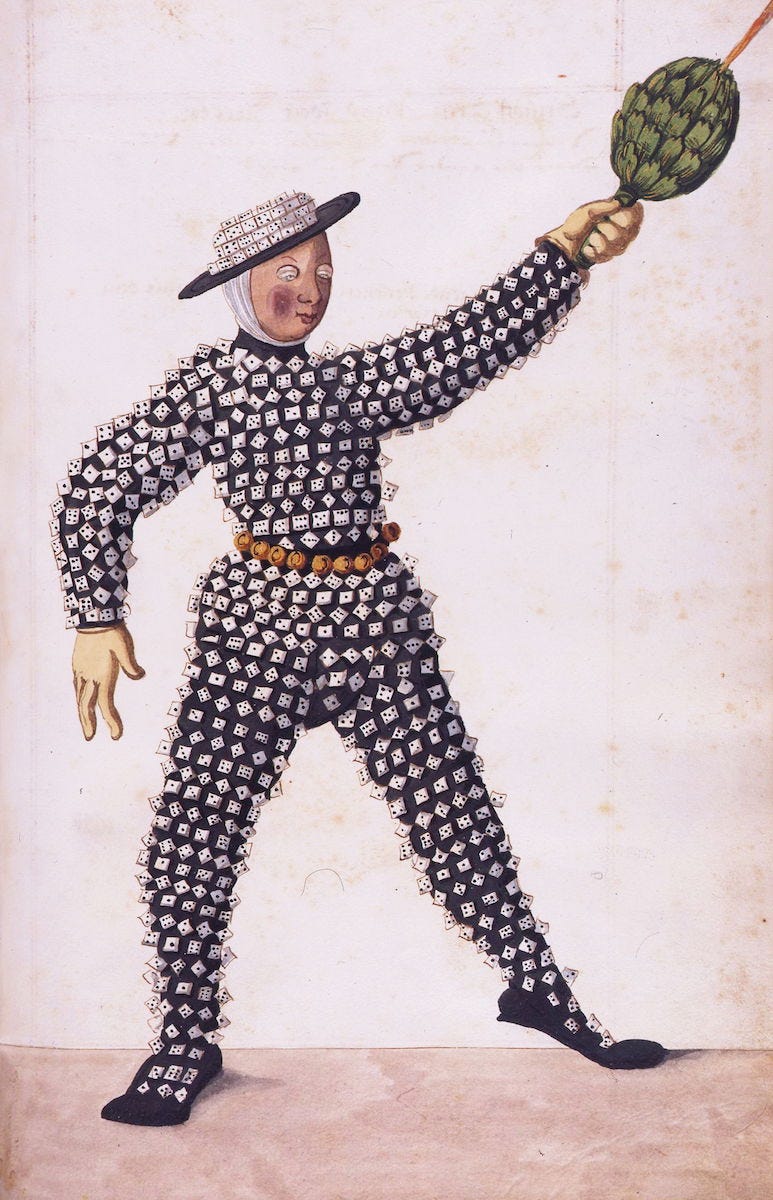
Five of them, which sit
along the shelf above my desk:
clear plastic with blue pips,
ensemble cast.
The faces facing out
are three, two, two, one, six,
just like the day I put them there
(though when that was
and why I did, I’ve no idea).
Well, I say, I guess that’s
where you live. You live right there.
(I have a mirror too.
Well, I say. There’s you.)
Which totals all the sense I have
of having landed anywhere,
of facing these six faces with my one. AAP
Loved the Colquhoun take on blending the sacred and ridiculous. That bit about buying an Elsan from a nun right after the mystical valley passage captures something real about how spirituality actually works in dailylife. Most people treat magic as this separate realm but she just lets them coexist naturally.
Would you consider digital subscription to the magazine? While the print version is a thing of beauty, at present the cost of shipping to Italy is double the subscription cost…